



Vol. 68, No. 1 * Pages 1–56 * January 2023
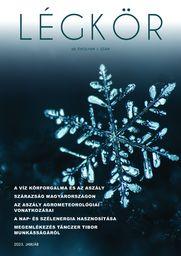 |
|
 download [pdf: 31231 KB]
Horváth Ákos, Breuer Hajnalka
DOI:10.56474/legkor.2023.1.1 (pp. 2–8)
PDF (4911 KB) |
Abstract
Possible reasons of the drought of 2022 is presented in this paper. Local, synoptic and large scale atmospheric phenomena were all together responsible for the extreme dry and hot weather that hit especially Carpathian basin. It is shown that on local scale the dry soil and lack of convection, on synoptic scale the blocking anticyclones, and on large scale the La Niña eff ect played the main roles in generation of extreme atmospheric conditions.
Szentes Olivér
DOI:10.56474/legkor.2023.1.2 (pp. 9–19)
PDF (4890 KB) |
Abstract
In 2022, Hungary and much of Europe experienced extreme drought. As a result of the persistently low precipitation, severe drought developed in many areas, peaking in the summer. The most severe drought in Hungary was inthe central part of the Great Hungarian Plain and in Trans-Tisza region. This study deals with the precipitation conditions in 2022, and the spatial and temporal variability of precipitation, the dry periods since the beginning of meteorological measurements, and the recorded extreme dry years and periods in the last 500 years.
Erdődiné Molnár Zsófia, Kovács Attila Viktor
DOI:10.56474/legkor.2023.1.3 (pp. 20–27)
PDF (7821 KB) |
Abstract
Rainfall and temperature are the two most important meteorological elements from the aspect of agricultural management. The long-term lack of precipitation has a great impact on crop production and animal husbandry. In historical times, extremely dry years like 2022 were always followed by famine in the given area (Réthly A., 1998), and although in the 21th century we do not have to fear this in Hungary, the drought still has serious consequences for food production. The drought did not aff ect the individual landscape units of our country to the same extent, so there were also signifi cant diff erences in crop yields. In our article, we review the characteristics of the severe drought experienced in the fi rst eight months of 2022 and its eff ects on agriculture.
Dobi Ildikó, Bíróné Kircsi Andrea, Péliné Németh Csilla
DOI:10.56474/legkor.2023.1.4 (pp. 28–39)
PDF (4403 KB) |
Abstract
This new series starts a new tradition in the renewable energy section of reformed "Légkör" Journal. A selection
has been prepared on the state of the energy sector including utilization of solar- and wind energy based on annually published international and domestic analyzes from global, European and Hungarian perspectives. We intend to focus on the news related to the weather. On this occasion we provide a brief overview on the international climate agreements and the most important domestic regulations that basically determine the operation of the energy sector. Within a few decades the decarbonization goals will fundamentally reshape the entire energy management of the planet. Weather-dependent renewable energy resources play an important role in energy transformation. The changes in the past two years are worth to considere together, as the pandemic in 2020 and the reorganization during the following year had an unprecedented impact on energy sector in many ways. What is common in the last two years is the unbroken exponential growth of solar and wind energy investments all over the world.

Kapcsolat: legkor@met.hu
SZERKESZTŐBIZOTTSÁG
SZERZŐI ÚTMUTATÓ
