



Vol. 70, No. 4 * Pages 190–240 * October 2025
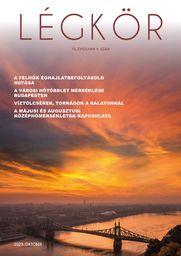 |
|
 download [pdf: 24852 KB]
Geresdi István
DOI:10.56474/legkor.2025.4.1 (pp. 190–199)
PDF (2643 KB) |
Abstract
Clouds play an important role in the climate. They influence the key climate characteristics, such as temperature and precipitation. However, they not only play a role in shaping the climate, but also respond sensitively to changes in individual climate elements. The processes that impact the characteristics of the clouds (e.g. optical and precipitation properties, updraft and downdraft) take place on an extremely wide scale, from micrometers to kilometers, and their formation and characteristics are strongly influenced by local variability of the surface or the atmosphere (several kilometers in extent). Such small-scale variabilities are extremely difficult to study using global observation and modelling systems. Although our knowledge of the role of clouds in shaping the climate has improved significantly in recent decades due to advances in measurement methods and numerical models, many important questions remain unanswered.
Allaga-Zsebeházi Gabriella, Szépszó Gabriella
DOI:10.56474/legkor.2025.4.2 (pp. 200–207)
PDF (2499 KB) |
Abstract
In this study, the impact of different adaptation actions on urban heat island was assessed using the SURFEX surface model for Budapest. In the simulations, the modification of the surface albedo of the urban areas as well as changing the green area and the included tree fractions were explored in detail. The results proved that these actions are able to significantly reduce the surface temperature in the city.
Kurcsics Máté, Komjáti Kornél
DOI:10.56474/legkor.2025.4.3 (pp. 208–215)
PDF (4297 KB) |
Abstract
Nowadays there have been increasing reports of spectacular, rotating water columns, so called waterspouts over the European seas. The phenomenon is frequent over the Mediterranean and Black Seas, but it also occurs along the Atlantic coast as well as over the North and Baltic Seas. Waterspouts are most frequent during the summer and autumn months, as their formation is associated with thunderstorms over warm sea surfaces. With the rising sea surface temperatures observed in recent decades, especially in the Mediterranean region, the occurrence of waterspouts has become more frequent. However, waterspouts are not limited to marine environments. They are recurring phenomena over Central Europe’s second and third largest lakes, Lake Geneva and Lake Constance. This raises a justified question: what is the situation at Central Europe’s largest lake, at Lake Balaton?
Babolcsai György
DOI:10.56474/legkor.2025.4.4 (pp. 216–219)
PDF (2907 KB) |
Abstract
For most of the past 50 years, there has been a significant relationship between the average monthly temperatures of May and August in Hungary. A warmer-than-average May was much more likely to be followed by a warm August than a cool one, and a cool May was more likely to be followed by a cool August than a warm one. This close relationship seems to have broken down since 2019, with cool Mays also mostly followed by warm Augusts. The following years will show whether this is a temporary phenomenon.

Kapcsolat: legkor@met.hu
SZERKESZTŐBIZOTTSÁG
SZERZŐI ÚTMUTATÓ
